
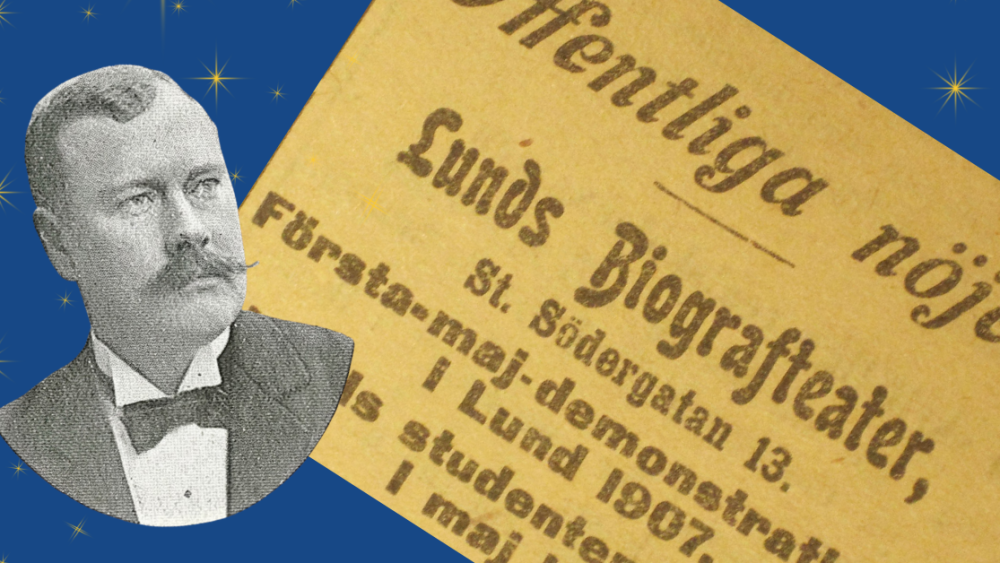
This year’s carnival film, Look up!, has premiered. In the lead-up to the 2026 carnival, Fredrik Tersmeden, Honorary Doctor of Philosophy and Archivist at Lund University, looks back and shows how students, film cameras and ideas about space have been intertwined in Lund since 1908. It all began with a teacher, a cinema and an unusually strong fascination with the stars.
On 2 May, the gala premiere of the 2026 carnival film Se upp! (Look up!) took place. Not invited? No need to despair. During the upcoming carnival days, there will be plenty of chances to catch this cinematic creation, in which a student suddenly turns invisible. The reason is not revealed here – but the fact that the female lead is named Stella, and that parts of the film were shot in the Astronomy Building on Sölvegatan, suggests that celestial phenomena – very much in keeping with this year’s carnival theme – are involved. This is far from the first time a carnival film has ventured into outer space. The 1998 production Blinka lilla stjärna (Twinkle, Twinkle, Little Star), for instance, was pure science fiction. But in fact, the links between astronomy and carnival films go back even further – indeed, all the way to 1908 and the very first films in the genre.
Teacher First – Then Student
The reason for this is a man named Karl Oskar Krantz (1867–1933). By the standards of his time, he was an unusual student: nearly 28 years old when he completed his secondary education at Spyken in June 1895 and enrolled at Lund University. The late start was likely due to financial constraints. Krantz came from a modest background – his father was a corporal – and had been forced to start working early to support himself. That he was academically gifted is clear, however, from the nature of his work: he was a teacher, primarily at the Malmö School of Navigation. He also continued this teaching alongside his early university studies, at a time long before the existence of state-funded student loans.
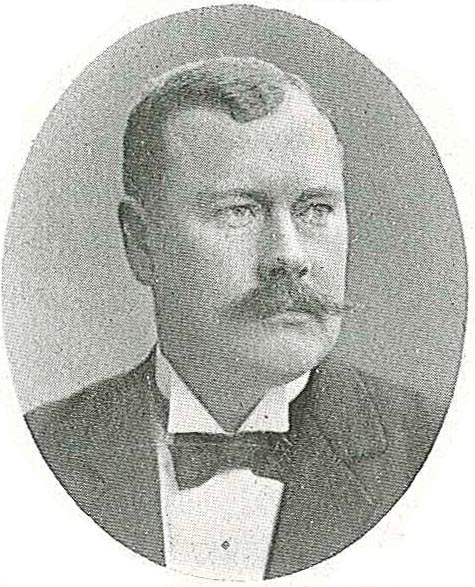
During his first years, Krantz’s studies were somewhat eclectic, ranging from mathematics to languages and theology. From 1902 onward, however, he focused entirely on the natural sciences, aiming for a licentiate degree. At the same time, he became involved in two pursuits that would prove highly significant for the history of the Lund Carnival. First, he got more engaged in student life, serving both as treasurer and senior member of Gothenburg Nation. Second – and perhaps as another way to finance his studies – he opened Lund’s second permanent cinema in April 1905.
Although travelling film screenings had taken place in Lund since 1899 – in venues such as Hotel Ahlström, the Academic Society (AF) and Folkets hus – film exhibitors at the time had to purchase films outright from producers and then tour them repeatedly to turn a profit. This business model discouraged permanent cinemas. In 1905, however, film rental was introduced to the European market, and Krantz was among the first in Sweden to seize this opportunity. Yet his ambitions extended beyond exhibition: he also became a film distributor and quickly grew into a major figure in the Swedish film industry in this role.
Lund’s First Film Producer
The next step for the clearly entrepreneurial Krantz was to start producing films himself. In 1907, he acquired a camera and began making documentary films. In his debut year, he released two: one documenting the student union’s address to the rector and another capturing the First of May demonstrations.
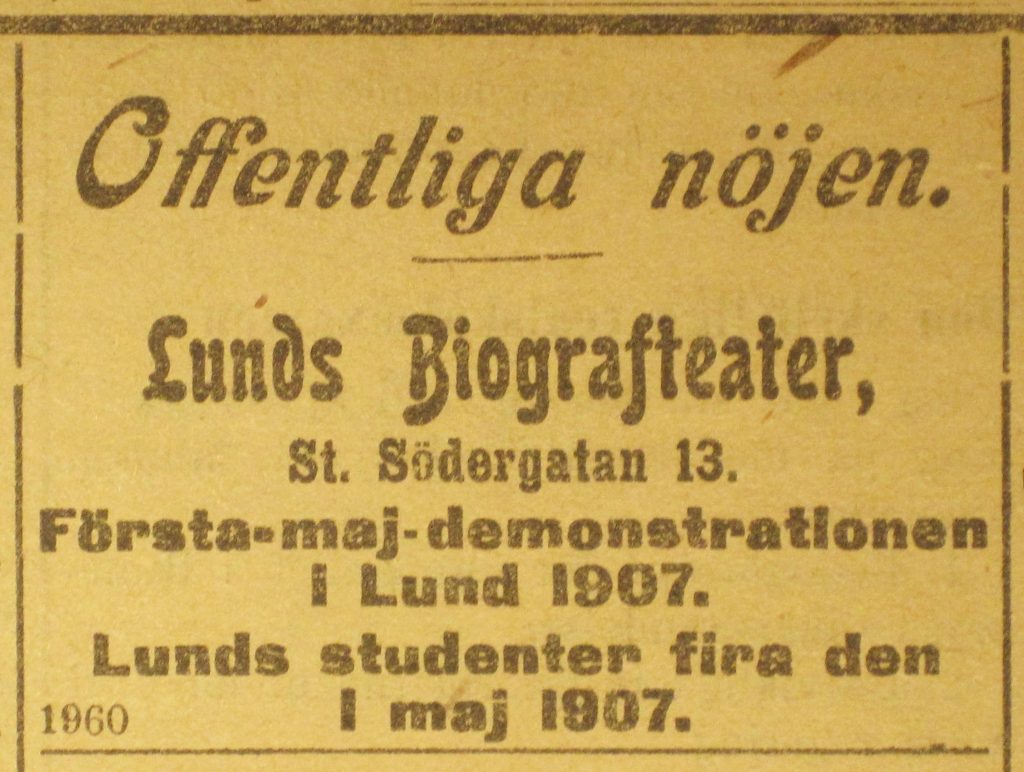
These were, as far as we know, the first films ever shot in Lund. Remarkably, they still existed as late as 1944, when Krantz’s son screened them at a special showing at the Reflex cinema. Whether they survive today is uncertain, as they are not listed in the Swedish Film Institute’s database. Nevertheless, film historian Lars Åhlander must either have seen them or obtained detailed written descriptions, as he recounts numerous specifics – including glimpses in the crowd of a young Per Edvin Sköld and a ten-year-old Wiven Nilsson.
The year after Krantz’s debut as a filmmaker, Lund hosted another student carnival. It is hardly a stretch to imagine that having such a dynamic representative of the film industry among the students encouraged them to embark on an ambitious project: producing not just one but five films for the carnival. Even more remarkably, these were fiction films – at a time when Sweden had virtually no domestic production of such works.
The most widely promoted film of the time
Of these five pioneering films, three are unfortunately lost. Surviving programmes reveal, however, that one was likely hand-coloured, while another was advertised as a “sound film” – achieved by placing a group of student singers behind the screen. Among the surviving works is the most widely promoted and discussed of the time: Lejonjakten (The Lion Hunt), a parody of the Danish scandal film of the same title from the previous year. It also included topical references to clashes between celebrating students and mounted police that had occurred during the Walpurgis Night festivities of 1908. The latter suggests the film was produced very quickly. Despite this, it was technically advanced for its era.
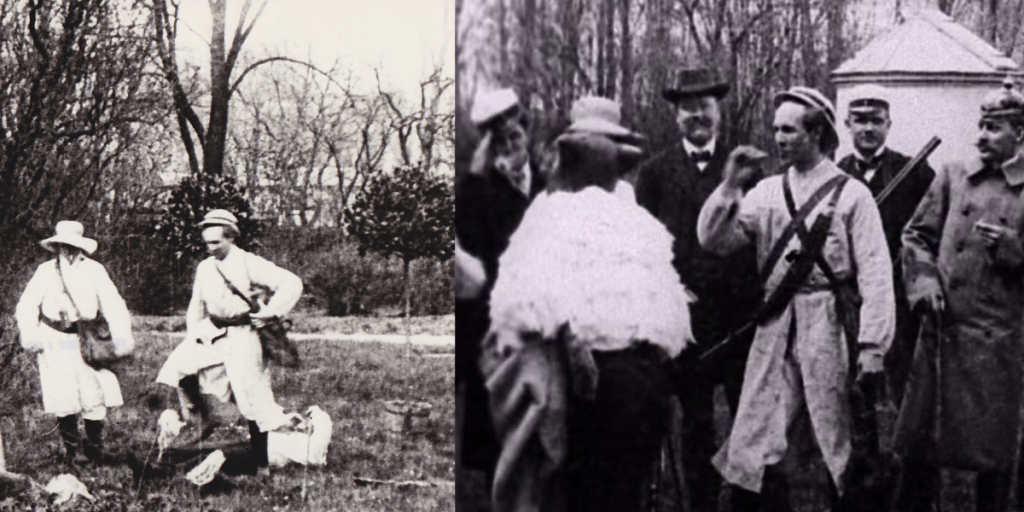
The authoritative reference work Swedish Filmography even describes it as “a marvel of perfection,” largely due to its use of smooth panning shots – difficult and rare effects given the heavy, primitive, hand-cranked cameras of the time – in no fewer than eight of the film’s eleven takes.
Double Celestial Connections
The Lion Hunt was filmed entirely in the park surrounding the University’s former observatory near Stadsparken, already providing a celestial link to this early example of the genre – but not the only one. The scientific field Krantz chose to specialise in was, in fact, astronomy. Although he left Lund for Stockholm in 1911 (partly to work as a censor for the newly established state film censorship board, but mainly to resume his teaching career), he appears to have maintained a kind of informal doctoral affiliation with the Department of Astronomy. In March 1927, he finally presented his licentiate thesis, The Distance and the Velocity Distribution of the Stars of Spectral Type K5 – a topic as celestial as they come.
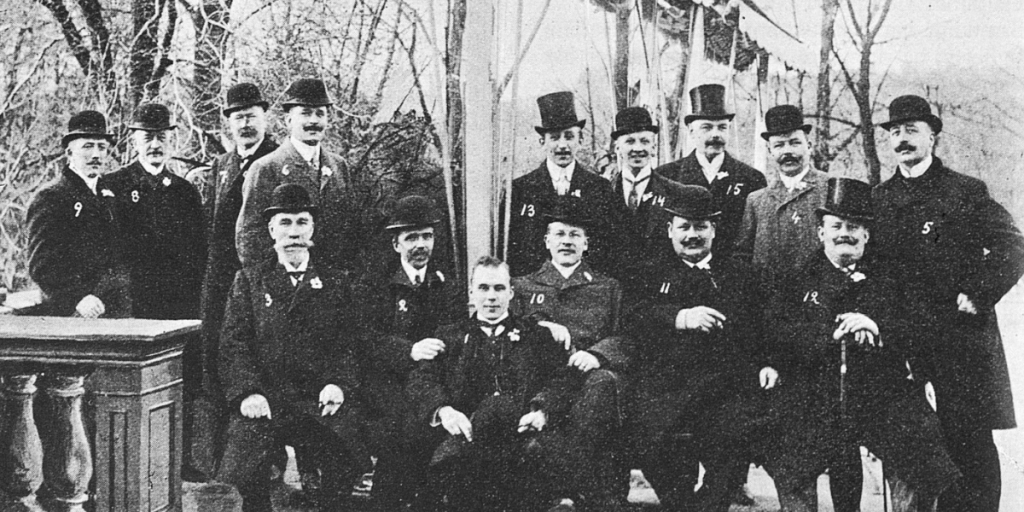
The tradition of carnival filmmaking continues to shine brightly to this day
Sadly, Krantz’s thesis has not been preserved in the University Archives, and his cinema on Stora Södergatan is also gone. Before its closure, however, it underwent numerous renovations and changes of ownership and name (older Lund residents may remember it as the Palladium), and for decades it was one of Sweden’s oldest operating cinemas. It finally closed in the mid-1990s, when SF opened its Filmstaden complex.
Yet the other star that Krantz helped ignite in Lund – the tradition of carnival filmmaking – continues to shine brightly to this day.
Fredrik Tersmeden
Archivist at the University Archives and contributor to several carnival films (including the astronomer Christer, in this year’s production)
Read more
A more extensive account of the life and work of Krantz can be found in the author’s book Lundensare – Universitetsöden under fyra århundraden (Lund, 2018), published by the Lund University Historical Society.
The Carnival film 2026
Look up! – A romcom about sight and perspective
When a star suddenly goes out, student Carl finds himself invisible to everyone except his corridor neighbour, Stella. Together, they must figure out what has happened and how to put things right before time runs out. With a wildly persistent suitor on their heels, Lund becomes the backdrop for an adventure filled with doorbells, love and a touch of magic.
Director: David Sjödin
Screenwriters: Johan Furuhjelm, Kajsa Metz, David Holmqvist and David Sjödin
Screening at Kino from 7 May, during the carnival weekend (22-24 May), as well as in between and possibly beyond.