

In this edition of Alum to Alum, we share a guest contribution from Lund University alumnus Arvid Pilhall. When it comes to choosing a health centre in Sweden, this alumnus wanted to make the decision process easier. Using open data and presenting the information in an easy-to-understand way, he created Vårdbetyg during the summer of 2026. Now he hopes that many fellow alumni will find useful and helpful.
Guest writer Arvid Pilhall
Arvid Pilhall, 32, lives in Malmö but grew up in Alingsås. He studied Computer Science and Engineering (Datateknik) at LTH from 2014 to 2020.
Choosing a health centre is one of the bigger decisions you make as a patient in Sweden, yet the facts have been hard to find. LTH alumnus Arvid Pilhall built Vårdbetyg to change that, with open data and a method anyone can check.
A choice with little to go on
If you moved to Lund to study, you probably had to choose a health centre (vårdcentral) at some point. Many of us pick the one closest to home, or the one a friend happened to mention.
Better information already exists. Patients all over Sweden answer the National Patient Survey, and the National Board of Health and Welfare publishes waiting times for primary care. But the numbers are spread across portals and PDF reports that few people have time to read, let alone compare.
I graduated from LTH in 2020 and work as a developer. In the summer of 2026, I decided to gather those numbers in one place and make them easy to understand. The result is Vårdbetyg, which roughly translates as “care rating”.
One score, and sometimes none
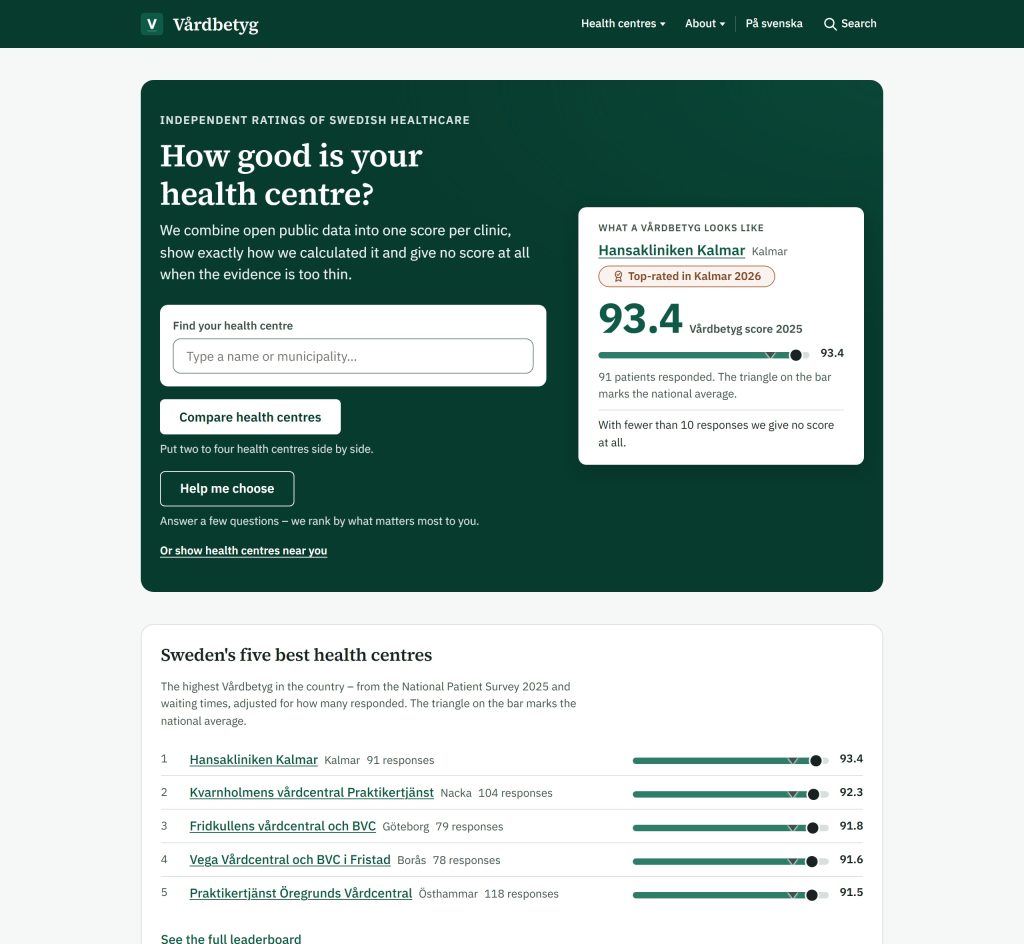
Vårdbetyg combines what patients answered with official waiting-time statistics, and turns it into one score from 0 to 100 per health centre. Where waiting times are available, patient experience counts for 70 percent and waiting times for 30.
Writing the code was the easy part. Fairness was harder. A clinic where only a handful of patients answered can end up at the top of a list by pure chance. So, results based on few responses are pulled toward the national average, a method called Bayesian shrinkage. Every page shows how many patients responded, and with fewer than ten responses the site gives no score at all. I would rather say “too few responses” than show a number that looks exact but isn’t. A missing score says nothing about the quality of care.
Fair to every clinic
Some decisions were about values rather than maths. The site never publishes a list of the worst clinics, because the point is to help people choose, not to single anyone out. No clinic can pay for a better position. There are no ads, and visitors are not tracked. The whole method is published, so anyone can check the maths.
Vårdbetyg is a one-person business. Its revenue comes from licences for the award seal and reports for care providers, and payment never affects a score.
From Lund to the whole country
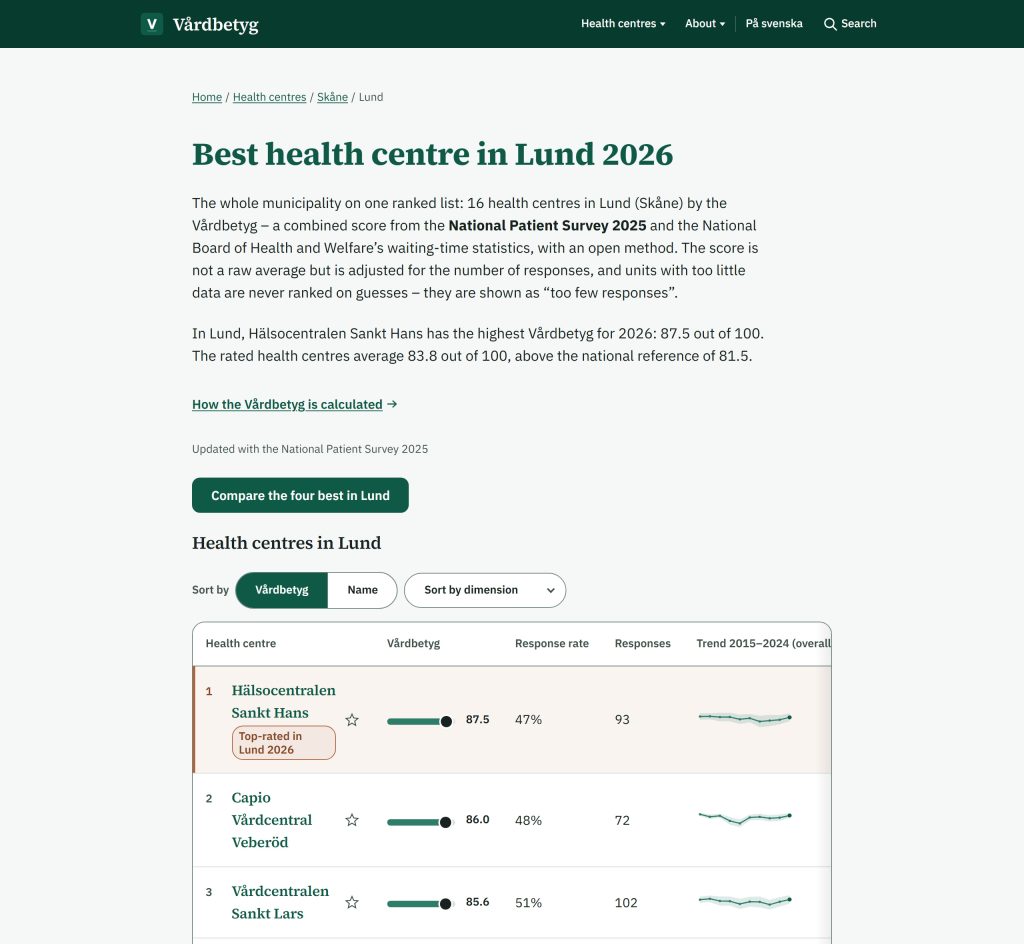
Today the site has results for 1,194 health centres in 290 municipalities, and 2,627 clinics in total now that emergency and specialist care are included. In Lund, all 16 health centres are on one ranked list and together they average 83.8, above the national reference of 81.5.
Local news outlets from Växjö to Märsta have written about the project, and Open Knowledge Sweden has highlighted it as an example of open data put to practical use. The site now gets around 20,000 visits a month.
A tip for fellow alumni
If you have an idea that depends on data, start by checking what is already public. Swedish authorities publish far more than most of us realise, and much of it is free to use. Getting hold of the numbers is usually the easy part. Making them understandable, and being honest about what they cannot tell you, is where most of the work lies.
Compare health centres near you at vardbetyg.se/en. The full method is at vardbetyg.se/en/metodik.
Text: Arvid Pilhall